Carl Sagan's Existentialism
An exploration into Carl Sagan's Existentialism
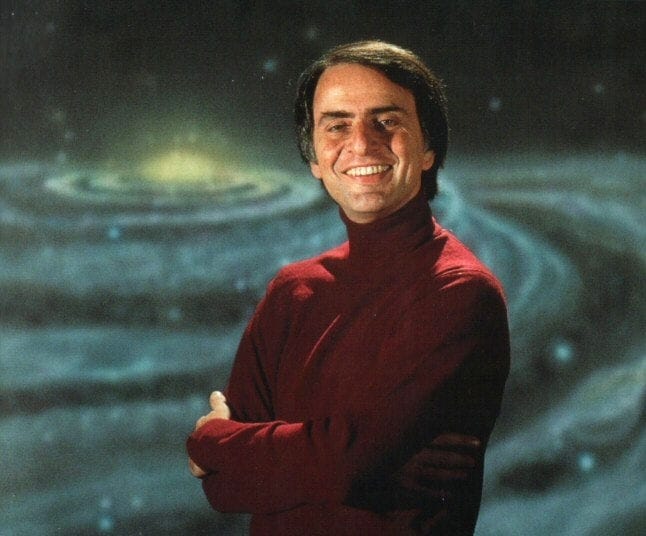
Carl Sagan is not regarded as an existentialist. You will not find him referenced anywhere by the big existential thinkers. Yet, he has done more for existential thought than most. Existentialism seems to flourish in times of tragedy or great peril. Times when people do not want to take a look, but are forced to. Carl Sagan became a writer during the peak of the Cold War. This is an era where everyone was afraid of W.W.II, the United States spent $10 Trillion on national defense, Russia and the United States had enough nuclear weapons to destroy the world a thousand times over. As J. Robert Oppenheimer delivers a speech shortly after the first detonation of an atomic bomb “We knew the world would not be the same. A few people laughed, a few people cried. Most were silent. I remembered the line from the Hindu scripture, the Bhagavad-Gita; Vishnu is trying to persuade the prince that he should do his duty, and to impress him, takes on his multi-armed form and says, ‘Now I am become Death, the destroyer of worlds.’ I suppose we all thought that, one way or another.”[1] Tensions were high. The world felt as if it was on the brink of destruction. Destruction impending on the choices of a select group of humans. One push of the red button could end everything. Our species now had the power destroy the world with a brash decision. Carl Sagan used the feeling of imminent destruction to examine the universe, and what it really means to be a human, bringing important questions and observations to the public eye. He encouraged questioning of religious doctrines and inspiring people to simply take a look. Which is why existentialism intertwines so perfectly into what Carl Sagan was doing. I believe existentialism is best used as a tool for psychoanalysis and as a form of examination on what it means to be a human being. This is what Carl Sagan dedicated his life to through his various publications and most famously his television show, “The Cosmos.” As he states “We humans are like a newborn baby left on a doorstep, with no note of explaining who it is, where it came from. What hereditary cargo of attributes and disabilities it might be carrying, or who its antecedents might be. We long to see the orphan's file.”[2] He used this sense of wonder and mystery to advocate science in all formats, and consequently, existential thoughts.
What does it all mean? This is a question every has asked, and everyone has their own answer to. The Existentialists say intrinsically nothing. Carl Sagan would say the same. Religious doctrines and various ideologies have claimed to know the answer. Giving humans a sense of purpose, and placing the earth at the center of the universe, even giving hopes of divine intervention. People flock to various views because thats what they find value and comfort in. This isn’t for me to demean their views, to each his own, but Carl Sagan and Existentialists alike encouraged people to ponder, “What if we aren’t special? What happens if the earth is not the center of the universe, and we are responsible for our peril?” As Carl Sagan says, “Extinction is the rule, survival is the exception.” This puts the human picture on the same causal chain as animals, which many people find uncomfortable. In asking these questions and in prescribing certain examinations is why people have resisted science and existentialism. It is not a biased look at things, but I believe an honest attempt to determine the workings of the world and the human experience. Existentialism has the self-inflicted stereotype of being depressing. Thus, making people resistant to the examination that is required. People do not want to look to true stories on the battlefield, stories genocide, murder, insanity, aloneness in the universe, however it is a crucial and uncomfortable look that must be had. These stories can show an aspect of true human nature. Carl Sagan took these lines of thought to the public sphere and many met him with resistance. Carl Sagan shares a poem that expresses this form of anxiety due to the findings of various scientific claims by Lillie Emery in his book “The Varieties of Scientific Experience”
“My kind didn’t real slither out of a tidal pool, did we?
God I need to believe you created me:
we are so small down here.”
A feeling of anxiety wasn’t what Carl Sagan longed for. Yet it can be a result of his work. People resists looks that shake their foundations, which is why often times science, and existentialism is met with fear and speculation. Carl Sagan writes, “The distasteful prospect of an indifferent Universe- or worse, a meaningless Universe-has generated fear, denial, ennui, and the sense that science is an instrument of alienation.”[3] This was a necessary process to Carl Sagan and existentialists alike, to feel this sense of aloneness in the universe. He was an advocate for people to questioning their views by taking a look at the Earth and where their dismal beginnings may lie, as opposed to being the descendant of kings, or gods. Science proclaims that we may have evolved from insignificant pond scum. Evolution being a delicate and violent process, that paints a different picture of the human experience. In doing this, I believe he had the same hopes along the lines of Sartre and other existentialists, that is, people will take up a sense of responsibility for their place and doing in the world. They did this through different methods, but the results were similar. Carl Sagan was more focused on the universe as a whole and the origins of life, while Sartre was focused on each individual's mind.
Sartre spent much of his early life stubbornly cementing the idea of radical freedom. He upheld that no matter the circumstance you are born into, there is always a choice to be made. He famously states, “that man being condemned to be free carries the weight of the whole world on his shoulders; and he is responsible for the world and for himself as a way of being.”[4] That is to say that they are consequently responsible for their choices, and what is going on in the world, just by being born into it. He turns to psychoanalysis to further drive his point about decisions, and to further attach a moral merit to our choices. He believed that through psychoanalysis an individual will come to realize the weight that their actions may carry. He states, “The principle of this psychoanalysis is that man is a totality and not a collection. Consequently, he expresses himself as a whole in even his most insignificant and his most superficial behavior. In other words, there is not a taste, a mannerism, or a human act which is not revealing.”[5] Every action you make according to Sartre, shows who you are as a human. His goal in doing this is to make an individual aware about their actions reflecting morality. He is trying to cram the individual with a sense of utter responsibility, for literally everything that they have done and will do, and the causal chain their choices may cause. The uncomfortable examination is crucial for an individual to develop this sense of responsibility for the world. There is a famous thought experiment that illustrates what Sartre is trying to say. It is called the “Trolley Dilemma”. The scenario is this; Let’s say you are in San Francisco enjoying your day, and you come up to the trolley station in hopes of catching an easy ride to the other side of town. As you approach the trolley you see on one side of the tracks, where the trolley is currently heading, there are five innocent people on one side of the tracks for unknown reasons. On the other side of the tracks there is one individual. You are standing next to the lever that can change the direction of the tracks. What do you do? If you don’t pull the lever five people die, but if you do pull the lever only one dies. This thought experiment attaches a sense of responsibility even in times of potential inaction. Which then turns into a form of action. Sartre I feel, is wanting people to come to this realization through psychoanalysis. Being morally responsible for everyone of my actions, and inactions, suddenly has a butterfly effect on the world. This is what Sartre wants us to feel. My actions then become a moral standard for the entire planet, and it’s fate. Instead of volunteering, or helping the homeless right now, I am writing this paper, and thus responsible for everything that I am not doing. Due to having the potential to be helping, but I choose not to. Or rather this needs to be part of my decision making process. This should make an individual want to become the best person possible, and take responsibility for the world, rather than letting injustices happen. Even though Sartre doesn’t directly state it, or it might not even be his goal. I believe he is making the world a better place through having people take an examination on what making a decision really entails. He attaches power through his examination, much like Carl Sagan.
One of the most important pictures ever taken in human history, Carl Sagan remarks, is that which is titled “The Pale Blue Dot.” It was a photograph taken by the Voyager spacecraft as it was passing by Saturn. The picture was taken hundreds of million miles away from earth, and Carl Sagan decided it would be one of our only opportunities to get a self portrait from that distance. He was wanting to make a statement. The result was; that earth looked like it was merely a “spec of dust, suspended in a sunbeam.” He wanted people to then meditate on this photograph, and ponder about our place in the universe from a cosmic perspective. The Earth looks dismal, and it wouldn’t be odd if the Earth wasn’t there at all. He remarks “Consider again that dot, that’s here, that’s home, that’s us. On it everyone you love, everyone you know, everyone you ever heard of, every human being who ever was lived out their lives. The aggregate of our joy and suffering, thousands of confident religions ideologies, and economic doctrines.” When viewing earth from this perspective two things happen. First, it makes everything look to insignificant. Everything that has ever happened suddenly appears meaningless and even purposeless. Humans have developed an ego about Earth and how special it may be, wanting to believe we are at the center of the universe. Yet, when looking at this photograph it all seems insignificant, it all happened on a spec of dust that can be easily swept away and overlooked. Carl Sagan much like existentialists, is wanting us to examine our meaning not only from an individual perspective, but as an intelligent species. However when doing this while looking at the pale blue dot, at first it is hard not to feel as if everything seems so meaningless from a cosmic perspective. He states “Our posturings, our imagined self-importance, the delusion we have supreme position in the universe challenged by this point of pale light, our planet is a lonely speck, in a great enveloping cosmic dark.” This sense of absence of intrinsic meaning makes an individual assess their own meaning and where they choose to apply it, because from the perspective of the photograph, earth appears meaningless. As Sartre says “Existence precedes essence”, this is the feeling Carl Sagan was trying to invoke with The Pale Blue Dot. Through this, much like Sartre’s psychoanalysis, brings out an incredible sense of responsibility with the realization.
As Carl Sagan states, “In our obscurity, in all this vastness, there is no hint that help will come from elsewhere to save us from ourselves. Like it Or not, for the moment, the earth is where we make our stand.” He is furthering his point that there is no hope for our future that is outside of our hands. We are responsible for the fate of the planet.This has many implications whether it may be environmental, nuclear, economical, religious. However, he simply wanted people to feel a sense of responsibility for their actions. He wanted people to realize how much their decisions affects our spec of dust and it’s future. He illustrates a similar point with a different metaphor, in another one of his books. As a child he received, “The World that Came in the Mail”[6], which was a self sustaining eco system inside of a glass ball. In the ball there were many organisms, the most dominant being shrimp. What makes these ‘worlds’ unique is that they require no human interaction, outside of keeping them out of incredible heat or unreasonable cold for life to prosper, much like our own planet. All was well until for unknown reasons to Carl, the shrimp started dying. The algae quickly consumed the shrimp, but the shrimp kept dying while Carl sat helpless, watching this world being destroyed by itself. He knew that if one part of this delicate ecosystem dies, then the rest of the eco system will collapse. This is much like our own planet. Humans have developed a sense of importance over other species on our planet, which is true, but other species are crucial to our survival. Religious doctrines have implanted the image into many peoples minds that some being will always be there to save us, to intervene when we are on the brink of destruction. However scientists and existentialists alike warn us that we are very capable and solely responsible for of our own destruction. Carl Sagan writes, “ It is probably too much to hope that some great Ecosystem Keeper in the sky will reach down and put right our environmental abuses. It is up to us. It should not be impossibly difficult. Birds-whose intelligence we tend to malign-know not to foul the nest. Shrimps with brains the size of lint particles know it. Algae know it. One called microorganism know it. It is time for us to know it too.”[7]
In conclusion, I believe that Carl Sagan shed a new light on existentialism. He employed existential thought differently than previous existential thinkers. He had a different agenda, he wanted people to learn about the world. He wanted people merely to do more good. The best way to do this for him, was to bring science to the public eye. In hopes that the beauty of the cosmos, and simply stating the way things work, will make the world a better place. He states that, “it has been said that astronomy is a humbling and character building experience. There is perhaps no better demonstration of the folly of human conceits than this distant image of our tiny world it underscores our responsibility to be more kindly to one another and to preserve and cherish the only home we have ever known; the pale blue dot.”
[1] www.youtube.com/watch?v=26YLehyMydo
[2] Shadows of Forgotten Ancestors, pg6.
[3] Shadows of Forgotten Ancestors, pg6
[4] Exisetntialism and Human Emotions, pg 52
[5] Existentialism and Human Emotions, pg68
[6] Billions and Billions, pg 75
[7] Billions and Billions, pg81